Written Commentary

What looks like a busy data calendar is primarily about the overnight run of Chinese and Norwegian inflation data, along with Japan’ Economy Watchers services survey and Current Account, with only Eurozone Sentix Investor Confidence, along with US Wholesale Inventories and Consumer Credit ahead. A busier day for central bank speakers has Fed’s Barr, Bostic, Daly & Mester, with BoE’s Bailey giving the annual Mansion House address this evening, while the Bank of Israel is expected to hold rates at 4.75%. China’s inflation data were both weaker than expected, with CPI unchanged y/y vs. expected 0.2%, paced above all by a sharp 7.2% y/y drop in Pork Prices, while PPI fell even more sharply than expected at -5.3% vs. prior -4.6%, with falling oil and coal prices, and some other commodity prices accounting for much of the drop. But both metrics attest to very weak domestic demand and pile on the pressure for a comprehensive stimulus package, which still remains elusive. By contrast, Norway’s CPI was stronger than expected at 6.4% y/y, though it is the record 7.0% y/y in Underlying CPI against market and Norges Bank expectation of 6.6%, which will likely ensure that the central bank keeps on hiking rates.
RECAP: The Week Ahead – Preview:
It may be the start of the summer holiday season in the northern hemisphere, but this week’s schedule is jam-packed with major data and events. Headlining the run of data are US and China CPI and PPI, the US also has the NFIB and Michigan Sentiment surveys, as China looks to Trade and Credit Aggregates. The UK has labour data, monthly GDP and activity indicators, RICS House Prices and BRC Retail Sales, while Japan has Machinery Orders and PPI, and India awaits CPI, WPI, Industrial Production & Trade.
On the central bank front, the Bank of Canada is expected to hike rates a further 25 bps to 6.0%, with the Bank of Korea and RBNZ seen on hold at 3.50% and 5.50% respectively. The Fed publishes its Beige Book, and the BoE its Q3 Bank Liabilities & Credit Conditions surveys, Q2 Financial Stability Report and Bank Stress Tests, and there will be a deluge of Fed, ECB and BoE speakers.
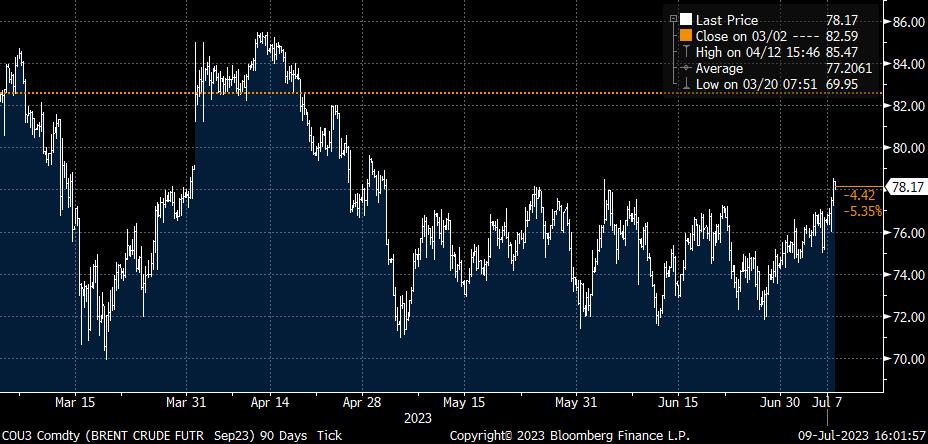
In the commodity space: EIA, IEA and OPEC publish their monthly Oil Market Reports, which will be accompanied by the USDA WASDE, China CASDE, France Agriculture Ministry and Brazil Conab reports. The IEA publishes its inaugural Critical Minerals Review, and the UN FAO its annual State of Food Security and Nutrition, and there is also the International Ministerial Meeting on Climate in Brussels. The oil market reports will perhaps be key to determining whether Brent Crude can break out of the choppy, but relatively tight $71-79 range that has held since the end of April (see chart).
The week will end with the start of the US Q2 earnings, as the usual run of banks and other financials report, while there are government debt auctions in the US, UK, Germany, Italy, Netherlands, Portugal and Japan.
In terms of the week’s data, the focus will be on US CPI, with both headline and core seen up 0.3% m/m, which thanks to energy and auto base effects would see headline slide to just 3.1% y/y from 4.0%, but core falling more modestly to a still high 5.0% from 5.3% y/y thanks mostly to housing (OER), and electricity prices. PPI will again likely confirm little in the way of pipeline pressures with headline seen at just 0.4% y/y from 1.1%, and core at 2.6% y/y from 2.8%. The Fed’s Beige Book will require some scrutiny, having suggested the economy was stalling in May, though incoming data has been a good deal more resilient; uncertainty about the economic outlook will likely feature again (which has been evident in a good many surveys), and there will be some focus on the impact of tightening credit conditions, which may well also show up in NFIB Small Business Optimism. On balance, particularly after the robust Average Earnings rise last Friday, markets will still continue to discount a very high probability of a July rate hike, and this week’s Fed speakers will likely stick to that script.
China’s inflation data get the week underway, with CPI seen steady at 0.2% y/y, despite some downside risks due to base effects. By contrast PPI is expected to fall at a faster pace of -5.0% vs. May -4.6% y/y, as oil and gas prices drag, and despite some upside base effects. Credit Aggregates are due in the early part of the week, with both Aggregate Social Financing and New Yuan Loans seen near doubling vs. May to CNY 3.05 Trln and CNT 2.3 Trln, as is typical at the end of a quarter, but with some risk that these may undershoot estimates, as credit demand remains weak, despite recent stimulative measures, and as the property sector woes continue to drag. The week ending Trade data are expected to see weakness in international demand weighing even more heavily on Exports, seen at -10.0% y/y, while Imports contract at roughly the same pace as May (-4.5% y/y), though mostly representing a fall in commodity prices. Be that as it all may, markets are focussed on the still elusive stimulus package, and whether all the fine rhetoric during Yellen’s four day visit to China last week is undermined by unilateral actions on both sides to prevent trade and investment.
The UK labour data will be the focal point in a bust week for statistics, above all Average Weekly Earnings that are expected to see headline accelerate to 6.8% from 6.5% y/y, while the ex-bonus measure is expected to dip to a still very high 7.1% y/y from 7.5%, as a close eye is kept on private sector wages growth (last 7.6% y/y), a downside surprise might be enough to prompt the MPC to revert to a 25 bps hike in August. The often heavily revised HMRC Payrolls are expected to be broadly steady at 25K, while the LFS Employment measure is seen slowing sharply to 89K vs. prior 250K, and the Unemployment Rate steady at 3.8%. May monthly GDP on Friday is expected to drop -0.3% m/m thanks to the Coronation bank holiday, which is also expected to drag all other monthly activity data modestly lower. The question is then how much of a rebound is seen in June (as is typical), which will determine whether Q2 GDP is broadly flat, or contracts modestly. A busy week for the BoE as it publishes its Financial Stability Report, Bank Stress Test results and its Credit Conditions and Bank Liabilities surveys, which will doubtless underline the scale of the much publicized headwinds to the UK housing market, and a further tightening of credit conditions, there will also be a particular focus on bank margins, after the usual media uproar about savings rates lagging changes in Base Rate.
Elsewhere German’s ZEW survey is forecast to show Expectations dipping to -10.5 from -8.5, and following a run of downbeat data to see Current Conditions slide to -62.0 from -56.5. Final national CPI readings in the Eurozone are also due. Japan’s Private Machinery Orders are expected to post a more modest gain of 1.0% m/m after April’s 5.5% m/m jump, while PPI is seen up just 0.2% m/m, allowing the y/y rate to fall to 4.4% from 5.1%. India’s run of key monthly data are forecast to see CPI rebound to 4.6% from 4.25% y/y due to food and petrol prices, while WPI will likely remain in negative territory at -3.2% y/y, with Industrial Production expected to accelerate to 5.2% from 4.2% y/y, premised on the stronger Manufacturing PMI, ongoing govt subsidies and a pick-up in Infrastructure Industries Output. Taken in aggregate, it will keep India as the world’s fastest growing major economy, and also sustain the RBI’s tightening bias, even as it keeps rates unchanged.
The US Q2 earnings season kicks off with the usual run of results from Citi, JP Morgan Chase, Wells Fargo and Blackrock. Overall Q2 earnings are seen down between -6.4% (Refinitiv) and -7.2% (Factset), though with a big drag from the Energy sector, in stark contrast to a strong quarter for Consumer Discretionary, as the attached graphic highlights. There will be particular focus on margins, retained earnings, planned layoffs, tightening credit conditions, and how often inflation and AI implementation is mentioned. Earnings highlights for the week according to Bloomberg News are likely to include: America Movil, BlackRock, Cintas, Citigroup, Delta Air Lines, DNB Bank, Fast Retailing, Fastenal, HCL Technologies, JPMorgan Chase, PepsiCo, Progressive, Qatar National Bank, Seven & i, Tata Consultancy Services, UnitedHealth Group, Wells Fargo.